Everwind's AI hyperscale project and its energy needs
© Larry Hughes, 2026
An earlier version was published in allnovascotia.com, 21 October 2026
Everwind Fuels has partnered with the AI firm Anthropic to build a 420-megawatt hyperscale data center (hyperscaler) in Richmond County. The buildout will occur in two phases, the first phase of 95-megawatts to be completed by the end of next year, and the second, 325-megawatts, by the end of 2028.
If the two phases are to operate with five-9s availability (five minutes downtime a year, the objective of most hyperscalers), the data centers will essentially run continuously throughout the year meaning the electricity load of the first, second, and combined phases will be about 0.83 terawatt-hours, 2.85 terawatt-hours, and 3.68 terawatt-hours, respectively.
The electricity loads of the two phases are significant when compared with Nova Scotia's other sectors; when the combined phases are operational, the hyperscaler will have the second highest load in the province (using Nova Scotia's 2025 loads):
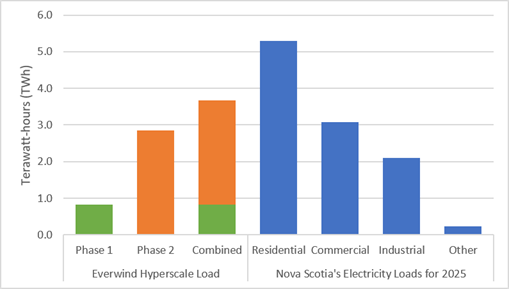
Everwind's hyperscale data center phase 1 and 2 and combined loads and Nova Scotia's 2025 electrical loads
As always, when it comes to projects such as Everwind's plans for a hydrogen-ammonia facility and now hyperscale data centers, Nova Scotians need to know where the electricity will come from to meet these loads.
According to Everwind, they have been assured by the province's Independent Energy System Operator (IESO) that Nova Scotia's grid and electricity suppliers have sufficient capacity to meet the needs of the first phase. This seems optimistic at present, given how close Nova Scotia came to rolling blackouts during a cold spell last January because of a decline in wind output.
If either Nova Scotia's or New Brunswick's proposed gas plants are available by the end of next year, perhaps Everwind could use excess capacity from them to meet the first phase's load.
Everwind plans to use 650 megawatts of wind generated by new windfarms for the project. The problem is that 650-megawatts will produce between 2.28 terawatt-hours (40 per cent capacity factor) and 2.56 terawatt-hours (45 per cent capacity factor) of electricity, but the second phase requires 3.68 terawatt-hours.
In other words, Everwind will need to find another 1.1 terawatt-hours to 1.4 terawatt-hours if the combined electricity load is to be met. This problem exists even if all the excess electricity from the 650-megawatts of windfarms can be stored in on-site batteries for subsequent use.
Possible sources of electricity include:
• Using a portion of the wind electricity originally intended for the German company E.On that cancelled its MOU with Everwind for 500,000 tonnes of ammonia.
• Having an agreement with the IESO to purchase electricity from Nova Scotia.
• Using on-site natural gas or diesel generators to handle periods of low or insufficient wind.
How Everwind plans to handle any shortages should be subject to public hearings as they could impact the electricity system or provincial emissions, or both.
However, since the Energy Minister/Premier has not introduced data center regulations, what happens is anyone's guess.