Nova Scotia's offshore wind resource and its known unknowns
© Larry Hughes, 2026
Published 28 September 2026, allnovascotia.com.
Energy Minister/Premier Houston returned from an extended stay at Prime Minister Carney's Investor Summit announcing that he had met with people who have an apparent interest in Nova Scotia's potential for offshore energy.
There is a catch though. Despite claims by the Energy Minister/Premier and others about how windy the offshore is, we know surprisingly little about the wind resource.
There is a very simple reason for this; Nova Scotia has seven buoys measuring offshore data, with none in the four designated Wind Energy Areas (Sydney Bight, Middle Bank, French Bank, and Sable Island Bank), as we can see when overlaying the Wind Energy Areas with the map of the province's offshore sensor buoys from NOAA's National Data Buoy Center:
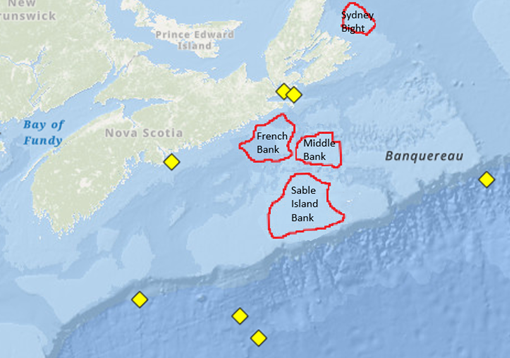
Map of Nova Scotia's offshore sensor buoys and the four designed Wind Energy Areas (Map overlaying: Author; Wind Energy Areas: CNSOER; Buoy locations: NOAA)
Nova Scotia's monitoring regime pales in comparison with the U.S. Eastern Seabord's offshore, where numerous monitoring buoys are in operation:
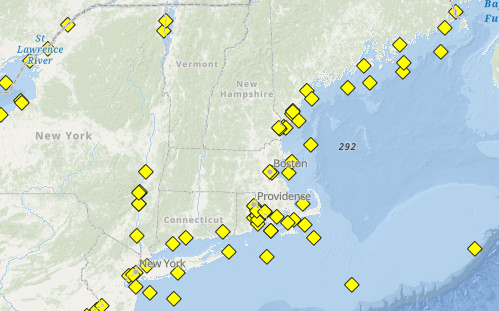
U.S. Offshore Wind monitoring buoys (Map: NOAA)
Further inland, Lake Ontario has 11 monitoring buoys and Lake Erie has well over 20; even Lake Champlain has two.
Very limited data exists for Nova Scotia's offshore wind resource, available primarily from historical records, ship observations, and satellite measurements. None of these come close to offering the quality of information that can be supplied by monitoring buoys measuring, for example, wind speed, gusts, wave height, and sea-surface temperature (SST).
If buoys are placed and maintained in each of the Wind Energy Areas and collect data from each area continuously over several years it will strengthen the case for projects such as Wind West.
The data would let offshore energy developers avoid sites with extreme winds, select more robust turbines when necessary, or both. It would also allow climatologists to modify existing climate models so we can better understand the effect of the possible effects of extreme weather events on the offshore caused by rising greenhouse gas emissions.
Right now, our knowledge of Nova Scotia's wind resource is what former U.S. Secretary of Defense Donald Rumsfeld would have called a "known unknown".
The question is, what actions will our Energy Minister/Premier take to make the resource a "known known"?