Climate and Drought Cloud Churchill Falls Picture
Larry Hughes
MacEachen Institute for Public Policy and Governance
Dalhousie University
AllNewfoundland&Labracdor.com
AllNovaScotia.com
20 August 2026
On Monday, Prime Minister Carney, Quebec Premier Frechette, and Newfoundland and Labrador Premier Tony Wakeham were in St. John's announcing the latest Churchill Falls-Gull Island agreement between Quebec and Newfoundland and Labrador.
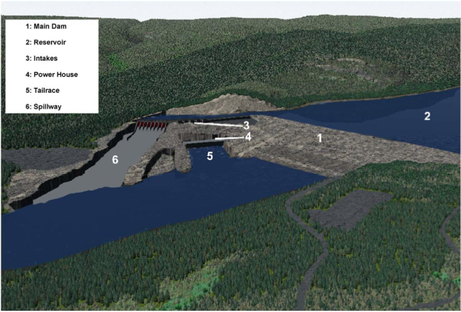
Gull Island Conceptual Model (Lower Churchill Hydroelectric Project EIA Review)
Prime Minister Carney emphasized that the projects were the largest clean energy investment in North American history, at nearly $70 billion. They will generate 14,000 megawatts of clean, renewable power nearly tripling the current generating capacity of Churchill Falls. (Higher than the 11,265 megawatts of capacity stated in the Definitive Cooperation and Implementation Agreement for both Newfoundland and Labrador Hydro and Hydro Québec.)
Quebec Premier Christine Frechette, recognizing Quebec's planned increase in provincial load by 150 to 200 terawatt-hours by 2050 and the upcoming Quebec election focused on the capacity (as opposed to generation), asked (of the PQ) Where will they find the 10,000 megawatts we are bringing to Quebec with that agreement? (Higher than the 9,015 megawatts of capacity stated in the Definitive Cooperation and Implementation Agreement for Hydro Québec.)
Premier Wakeham's plans for the development of natural resources in Newfoundland and Labrador were noted when he said, "This is a win-win-win for Newfoundland and Labrador, the federal government, and Québec. We are finally replacing the notorious 1969 Churchill Falls deal and the 2024 MOU with a new deal that will guarantee us more power, more value, and more transmission."
All the superlatives and apparent contradictions notwithstanding, there were three words that didn't get the emphasis they deserved.
Climate change.
Drought.
In 2023, the fourth and final dam of Hydro Québec's 1,550-megawatt La Romaine hydroelectric complex was completed. La Romaine is expected to produce eight terawatt-hours of electricity a year.
Despite the completion of the La Romaine complex in 2023, Hydro Québec's lowest and second and fourth lowest production years occurred in 2024, 2025, and 2023, respectively; the worst and sixth worst first quarters (Q1) occurred in 2024 and 2026:
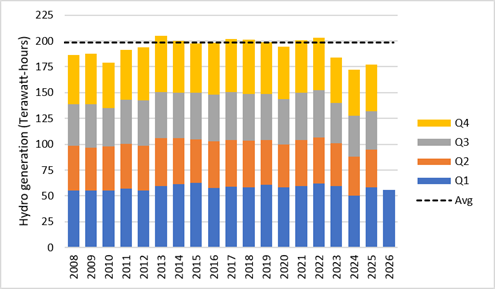
Quebec's quarterly hydroelectric generation from 2008 to 2025, plus first quarter of 2026 (Q1: January to March); Avg refers to the average production between 2013 and 2023 (Chart: Author; Data: Statistics Canada Table 25-10-0015-01)
Quebec is experiencing rising temperatures that can cause snow to fall as rain as well as lead to droughts such as in 2023, 2024, 2025, and now 2026.
In 2022, the 824-megawatt Muskrat Falls hydroelectric facility in Labrador was finally completed, bringing the province s total generating capacity to about 7,586 megawatts.
Extra generating capacity should mean more production from hydroelectricity, and it did, briefly in 2023, reaching 44.9 terawatt-hours, the greatest production since 2008. Since then, production has fallen, in 2024, it was the fifth highest, while in 2025, it was the lowest since 2008. First quarter production was the second and third lowest since 2008 for 2026 and 2024, respectively:
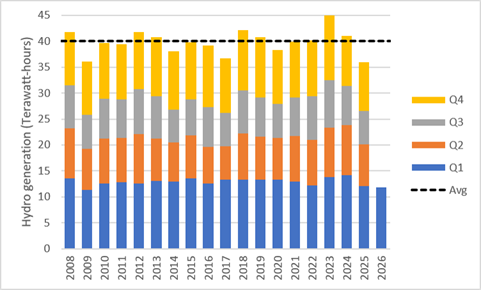
Newfoundland and Labrador s quarterly hydroelectric generation from 2008 to 2025, plus first quarter of 2026; Avg refers to the average production between 2013 and 2023 (Chart: Author; Data: Statistics Canada Table 25-10-0015-01)
According to data from the Arctic Regional Climate Centre Network, over the past few years Labrador and parts of the island of Newfoundland have experienced increasing temperatures and declining precipitation. These changes have resulted in drought conditions in areas of Labrador and the island of Newfoundland, coinciding with the decline in hydroelectric output.
In both Quebec and Newfoundland and Labrador, the direct and indirect effects of rising temperatures drought are affecting hydroelectric generation. The addition of wind power in both Quebec and Newfoundland and Labrador could help alleviate this, but changes in the climate are expected to increase the likelihood of wind droughts.
Large renewable projects, such as the Churchill Falls Expansion, are subject to the vagaries of the climate. Before committing billions of dollars to these projects, a detailed analysis of the potential long-term risks of climate-induced drought to Quebec and Labrador needs to be conducted.